FREE Canary SEND Toolkit: How to Get Alternative Provision (Even Without an EHCP) (2026 Edition) – Guide + Editable Letter
When a child can’t attend school, families are often told nothing can happen until there’s an EHCP. That isn’t the law. The reason could be anxiety, burnout, exclusion, illness or a placement breaking down.
Under Section 19 of the Education Act 1996, your council must arrange a suitable education for any child of compulsory school age who would otherwise go without one. This applies whether or not your child has an EHCP, and whether or not you’ve asked for one. The education should be full-time, unless your child’s health means less is in their best interests for now.
Updated October 2026. This edition is completely rewritten, and includes what the Government’s proposed SEND reforms could mean for children out of school.
What’s inside
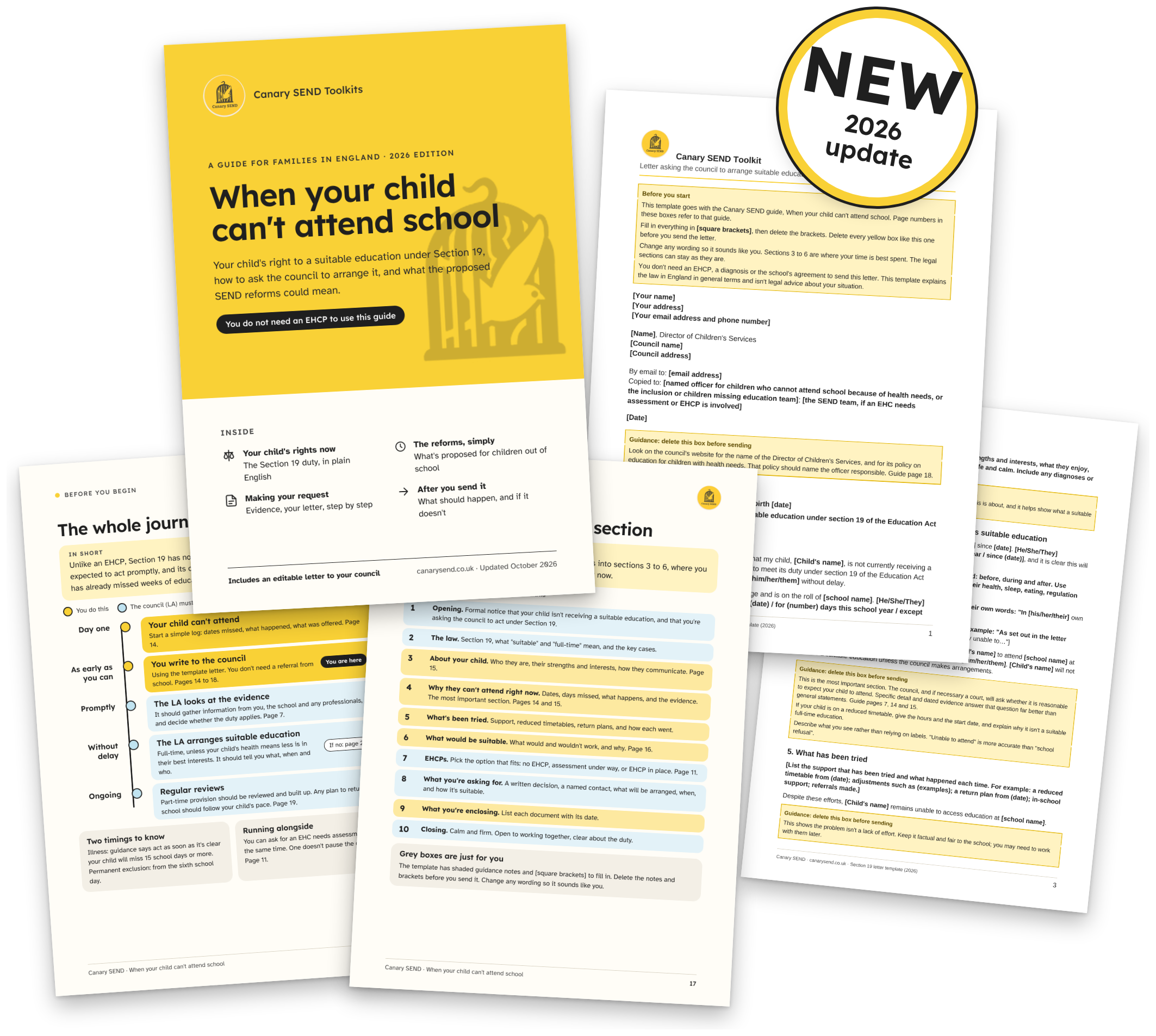
1. The guide (PDF, 23 pages)
A plain-English guide you can read in order or dip into when you need it. Every page starts with an “In short” box. It covers:
when the Section 19 duty starts, and the timings councils should follow
how councils and courts decide, and how to evidence why school isn’t possible for your child right now
what “suitable” really means, and what often isn’t
calm responses to what families commonly hear, such as “wait for the EHCP”, “it’s the school’s job” or “we need a consultant’s letter”
what to do if you felt pushed into home education
how Section 19 fits alongside EHCPs and EOTAS
what should happen next, and how to challenge a refusal or delay, including complaints and the Ombudsman
2. The editable letter (Word)
A letter to your council with the legal wording already written. You fill in the parts only you can write: who your child is, why they can’t attend right now, what’s been tried, and what would work. Yellow guidance boxes tell you which page of the guide to look at for each section.
What makes it different
Councils often refuse by asking whether it’s “reasonable” to expect a child to attend. This toolkit helps you answer that question before they ask it, with clear, specific evidence. It also helps you describe your child in a way that reflects who they are, rather than labels like “school refusal”.
Format: downloads as a ZIP with the PDF guide and the Word letter
Best for: families whose child is out of school or on a reduced timetable, with or without an EHCP
This toolkit explains the law in England in general terms and isn’t legal advice about your individual situation.
How to download
When you check out, you’ll be asked for your name, email address and address. Squarespace’s checkout requires an address even for free downloads. I don’t use it for anything other than keeping a record of your order. You’ll also be asked to tick a box confirming the toolkit is for your own family or personal use.
Once you’ve checked out, your download links will appear on the next page. You’ll also get two emails: one confirming your order, and one with your download links. The links expire after 24 hours, but clicking an expired link will send you a new one. If the emails don’t arrive, please check your spam or junk folder first. If you still have any problems, get in touch at info@canary-send.co.uk.
Free for families and individuals. Professionals and organisations, please get in touch before using them.